Moroccan Fountains: Water, Architecture and Community Life

Phone
+212 660 44 471

Contactyourtourguide@gmail.com

Office
1111 rue El,Rue koufa Essaouira 44000

Hours
Monday-Sunday:
24/7
Moroccan Fountains: Water, Architecture and Community Life
Across Morocco’s historic medinas, small fountains appear between houses, mosques, markets, workshops, and narrow passageways. Some are simple openings in a wall, while others display colorful zellige, carved plaster, painted cedar wood, inscriptions, and elegant protective canopies.
Before household plumbing became widespread, these public fountains provided essential water for residents, travelers, artisans, and sometimes animals. They formed part of a wider urban system connecting springs, rivers, wells, underground channels, cisterns, hammams, gardens, mosques, and private homes.
The word “sacred” does not mean that Moroccans worship the fountains or the water inside them. Instead, it refers to water’s connection with cleanliness, hospitality, religious purification, and charitable service. Providing accessible water was considered a valuable act that benefited the entire community.
Today, many historic fountains are admired mainly for their architecture. Yet their original meaning was practical and social. They were built to be used, and their beauty transformed an everyday necessity into a visible expression of generosity and craftsmanship.
In this guide, we will explore the history of Moroccan public fountains, their architectural features, their place within traditional water systems, and the most important examples travelers can discover in cities such as Fes and Marrakech.
Understanding the Moroccan Saqaya
A traditional public fountain in Morocco is commonly called a saqaya.
The term refers to a structure that provides water, usually through an opening or tap connected to a basin. Different spellings may appear in English, including saqaya, saqqaya, seqqaya, or siqaya.
In other parts of the Islamic world, a public drinking fountain may be known as a sabil. The design and terminology vary between countries, but the central purpose is similar: making water available in a shared public space.
A Moroccan saqaya can be:
- Attached to a mosque
- Built along a street
- Integrated into a market
- Located beside a funduq
- Connected to a hammam complex
- Placed near a city gate
- Constructed as part of a palace
- Included inside a private riad
- Combined with drinking troughs for animals
Public street fountains should not be confused with decorative courtyard fountains. Both belong to Moroccan water architecture, but they served different needs.
Why Water Was So Important to Moroccan Cities
Morocco contains several climates, from Mediterranean and Atlantic regions to mountains, plains, oases, and dry pre-Saharan landscapes.
Water availability strongly influenced where cities developed and how neighborhoods were organized.
A reliable water supply was necessary for:
- Drinking
- Cooking
- Washing
- Religious purification
- Gardens and agriculture
- Hammams
- Craft production
- Animals
- Markets
- Public cleanliness
Historic cities required systems capable of transporting and distributing water without electric pumps.
Engineers and local communities used the natural slope of the land, underground channels, reservoirs, rivers, wells, and gravity-fed networks.
The public fountain represented the visible end of a much larger system. Behind a small decorated wall could be an extensive network of channels and carefully managed water rights.
Life Before Household Plumbing
Today, turning on a household tap requires little thought. In the past, obtaining water was a regular part of daily life.
Not every house had a private well or direct connection to a water network. Residents visited the nearest fountain and carried water home in containers.
The distance between a house and its water source influenced the rhythm of the neighborhood. Fountains needed to be located where residents could reach them through the medina’s narrow streets.
People might visit several times a day depending on family size and household needs.
This made the fountain more than a utility. It became a familiar meeting point where neighbors regularly saw one another.
The Sacred Meaning of Water
Water has an important place within Islamic culture.
It is connected to cleanliness and to wudu, the ritual washing performed before prayer. Mosques therefore require access to suitable water for their worshippers.
However, the water used for ablution was not always taken directly from a decorative street fountain. Many mosques had separate ablution rooms or attached facilities designed specifically for purification.
Public fountains served the wider community by providing drinking and household water.
The spiritual importance of giving water helped encourage rulers, merchants, scholars, and wealthy families to finance fountains as acts of charity.
When a fountain continued serving people after its founder’s lifetime, the benefit of the donation also continued.
Water as an Act of Charity
Building or maintaining a fountain could form part of a charitable endowment known in Morocco as habous and elsewhere as waqf.
A patron might provide money, property, or commercial income to support a public service.
Such endowments could help finance:
- Mosques
- Schools
- Fountains
- Hammams
- Roads
- Bridges
- Accommodation for travelers
- Religious and social services
The fountain allowed the donor’s generosity to become part of everyday city life.
An inscription might record the name of the patron, the construction date, a religious expression, or a statement about the importance of water.
Not every fountain was created through the same legal arrangement, but charitable sponsorship played an important role in the wider tradition.
The Public Fountain and the Mosque
Many historic Moroccan fountains stand near mosques.
This location was practical because the area already required a dependable water supply. The same network could serve the mosque, ablution facilities, hammam, fountain, and surrounding neighborhood.
Mosques were also central points within traditional urban districts.
A neighborhood often developed around a group of shared institutions that included:
- A local mosque
- A communal oven
- A public fountain
- A hammam
- Small shops
- Artisan workshops
- A Quranic school
Together, these institutions supported the daily and spiritual life of residents.
The fountain made water available outside, including to travelers or residents who were not entering the mosque.
How Water Reached the Fountains
Moroccan cities did not depend on one universal water system.
The sources and engineering techniques differed according to geography, climate, available technology, and historical period.
Water could arrive through:
- Natural springs
- Rivers and streams
- Wells
- Underground drainage galleries
- Aqueducts
- Gravity-fed channels
- Cisterns and reservoirs
- Rainwater collection
- Mountain water networks
The system required continuous maintenance. Blocked channels, damaged walls, contamination, and changes in water flow could interrupt the supply to an entire neighborhood.
Specialized workers and local authorities therefore played important roles in managing the network.
The Water System of Fes
Fes developed in a valley with access to springs and the Oued Fes river system.
Water channels supplied houses, gardens, mosques, hammams, workshops, mills, and public fountains.
The network helped Fes become a major urban and commercial center. Water supported industries such as tanning, dyeing, food production, and other crafts.
Street fountains became important landmarks within the medina’s maze of lanes.
UNESCO includes fountains among the principal architectural and urban elements that define the historic Medina of Fes. Many of these structures developed during the city’s most important periods of growth. UNESCO World Heritage Centre
The distribution network was complex because water needed to serve both clean household uses and activities that could produce waste. Managing the movement of clean and used water was therefore essential.
The Khettaras of Marrakech
Marrakech developed in a drier environment near the foothills of the High Atlas Mountains.
One of the systems historically used to supply the city and its gardens was the khettara.
A khettara consists of a gently sloping underground channel that collects groundwater and transports it toward settlements or agricultural land using gravity.
Vertical shafts are placed along the route. During construction, workers use them to remove earth and access the tunnel. Later, they allow ventilation, inspection, and maintenance.
Khettara systems helped supply:
- Public fountains
- Mosques
- Hammams
- Houses
- Gardens
- Agricultural land
- Reservoirs
Their success depended on detailed knowledge of landscape, water tables, slope, soil, and maintenance.
Many historic khettaras have declined because of groundwater changes, modern wells, urban expansion, and reduced maintenance. They nevertheless remain an important part of Morocco’s hydraulic heritage.
The Architecture of a Street Fountain
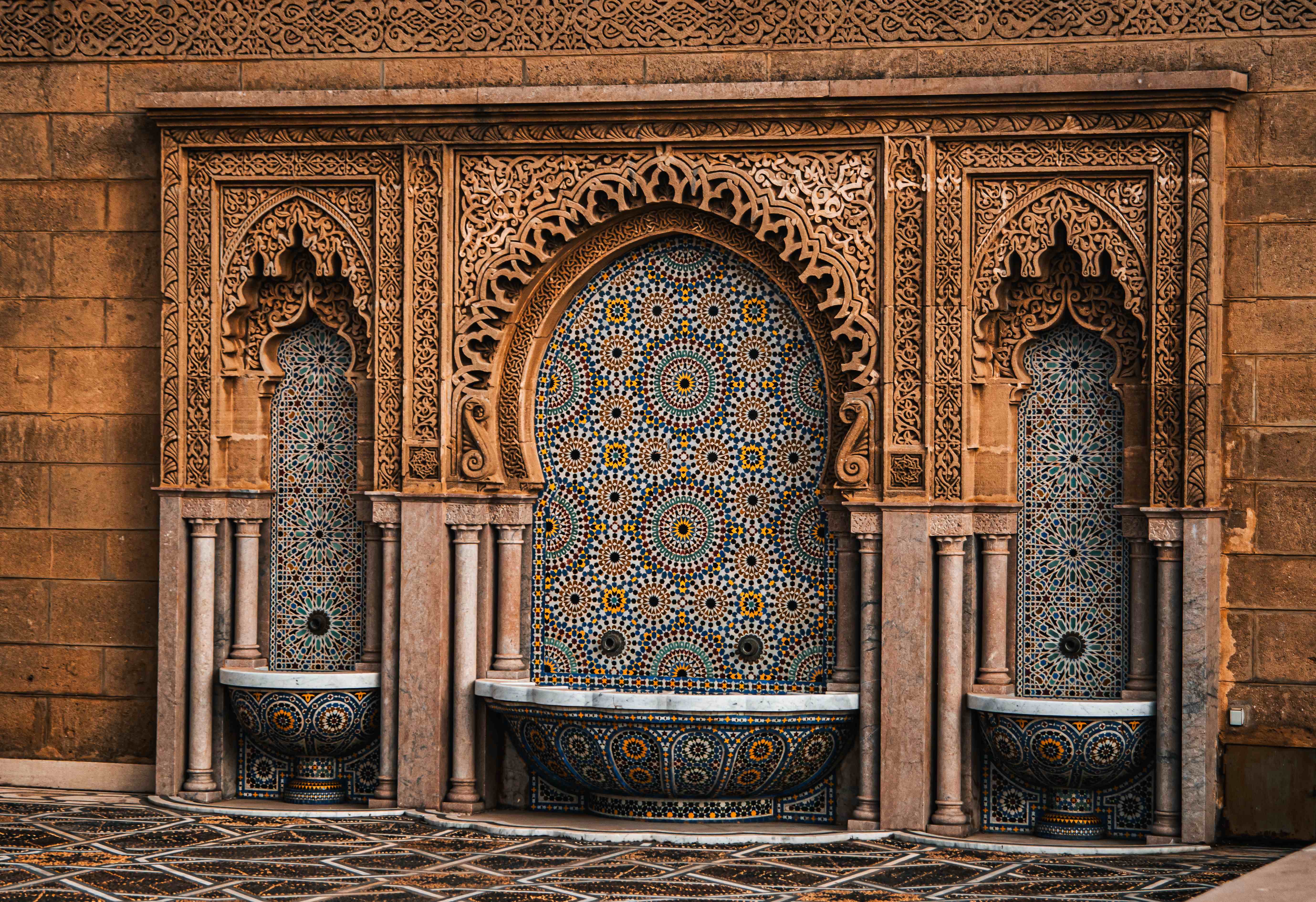
A Moroccan street fountain is often built into a wall rather than placed in the center of a large square.
This design protects the structure and allows people to collect water without blocking the narrow lane.
A decorated fountain may contain several architectural elements.
The Niche
The water outlet and basin are placed inside a recessed opening.
The niche may be rectangular or shaped by a horseshoe or pointed arch. Its depth creates shade and protects the decorative surface.
The Basin
Water falls into a stone, marble, or tiled basin.
Some basins are positioned at a height suitable for filling household containers. Others are lower or connected to separate troughs.
The Zellige
Geometric zellige can cover the wall behind the water outlet.
The glazed tiles resist moisture while adding color and pattern. Green, blue, white, black, and earthy tones are commonly found.
Carved Plaster
Stucco may surround the arch with geometric, floral, or calligraphic decoration.
Because plaster is vulnerable to water and weather, damaged sections require careful restoration.
The Cedar Canopy
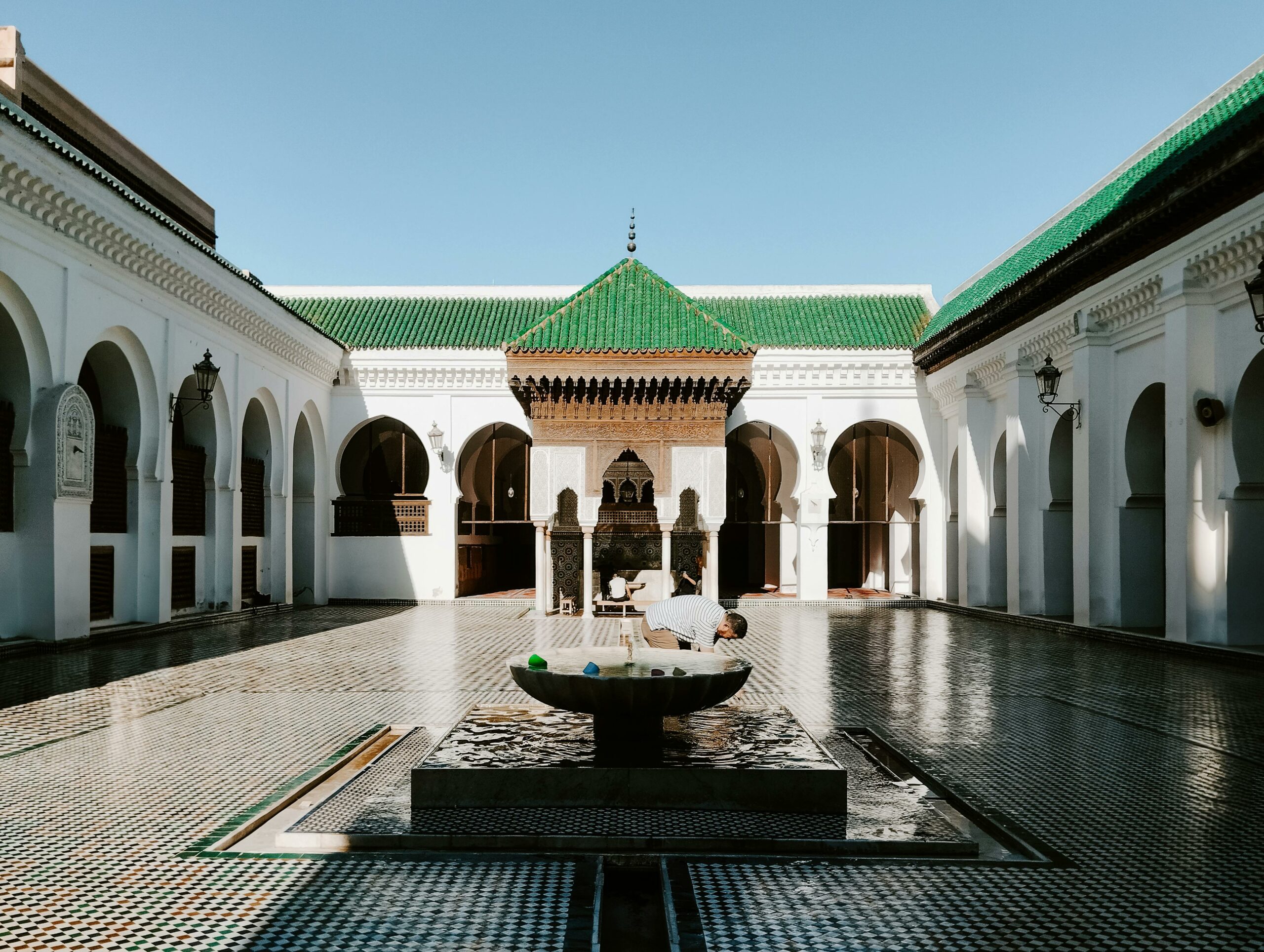
Many monumental fountains have a carved wooden canopy projecting above the opening.
The canopy provides shade and helps protect the decoration. It can include painted patterns, carved brackets, muqarnas, and green roof tiles.
Inscriptions
Arabic calligraphy may include blessings, religious expressions, construction dates, or information about a patron.
The inscription gives the fountain a voice, connecting its practical function with cultural and ethical meaning.
Beauty With a Practical Purpose
The decoration of Moroccan fountains was not separate from their function.
Zellige creates a surface that handles moisture better than untreated plaster. A projecting canopy protects the wall from sun and rain. Stone basins resist regular use.
Artisans transformed these practical materials into an organized composition.
The fountain could display the work of:
- Zellige cutters
- Plaster carvers
- Woodworkers
- Painters
- Calligraphers
- Stonemasons
- Metalworkers
- Hydraulic specialists
One small façade therefore brought together several Moroccan crafts.
Monumental and Neighborhood Fountains
Not every fountain was richly decorated.
A prominent fountain beside an important mosque, market, or funduq might receive extensive artistic treatment.
A smaller neighborhood saqaya could have a simple plastered wall, one water outlet, and a basic stone basin.
Both types were important.
The monumental fountain demonstrated patronage and craftsmanship, while the modest fountain ensured that water reached ordinary residential lanes.
Focusing only on the most decorated examples can hide the wider network that made urban life possible.
Nejjarine Fountain in Fes
The Nejjarine Fountain is one of Morocco’s best-known historic fountains.
It stands in Nejjarine Square beside the Funduq al-Nejjarine, which now houses a museum dedicated to wooden arts and crafts.
The fountain’s façade includes:
- Geometric zellige
- Carved stucco
- An arched composition
- Decorative columns
- A projecting carved wooden canopy
The word Nejjarine refers to carpenters, reflecting the traditional artisan activity associated with the surrounding area.
The fountain and funduq create an integrated urban ensemble combining water, commerce, accommodation, craftsmanship, and public space.
Its location also shows how fountains helped people navigate the medina. A resident could use a well-known saqaya as a meeting point or directional landmark.
Mouassine Fountain in Marrakech
The Mouassine Fountain is one of Marrakech’s most important examples of Saadian water architecture.
It forms part of the sixteenth-century Mouassine religious and neighborhood complex.
The wider complex included a mosque, hammam, ablution facilities, educational spaces, and the public fountain.
The structure provided drinking water for people while neighboring openings were historically connected to troughs for animals.
Its long façade, carved cedar elements, plaster decoration, and protected openings make it more monumental than a typical neighborhood fountain.
The fountain demonstrates how a single water system could support religious, domestic, commercial, and animal needs within one district. Architectural information and images of the structure are documented by Archnet.
Shrob Ou Shouf Fountain
Another famous Marrakech fountain is Shrob Ou Shouf, located near the Ben Youssef area.
Its name is commonly interpreted as “drink and look.”
The expression encourages visitors to use the water while also admiring the craftsmanship surrounding it.
The fountain dates to the Saadian period and includes a large wooden canopy with carved and painted decoration.
Unlike a palace fountain hidden behind walls, Shrob Ou Shouf faces the street. Its beauty was created for the public urban environment.
The structure turns the simple act of collecting water into an encounter with architecture.
Bab Doukkala Fountain
The Bab Doukkala complex contains another important example of Saadian fountain architecture.
Like Mouassine, it was connected to a wider neighborhood complex involving religious and public services.
Marrakech’s World Heritage documentation identifies the fountains of Mouassine, Shrob Ou Shouf, and Bab Doukkala as important examples of the city’s Saadian architecture, particularly for their decorated plaster and woodwork. UNESCO and ICOMOS
Together, these fountains show that water distribution was considered part of major urban planning rather than an isolated technical problem.
Fountains in Tetouan and Northern Morocco
Northern Moroccan cities developed fountain traditions influenced by local geography and Andalusian urban culture.
Tetouan’s medina includes fountains integrated into streets, houses, mosques, and neighborhood spaces.
Chefchaouen is also known for public water points and fountains supplied by nearby mountain sources.
In these cities, whitewashed walls, colored tiles, stone basins, and flowing water create a visual style different from the ochre architecture of Marrakech.
Tangier historically contained streets and squares named after public fountains. Even where a fountain has disappeared, the name can preserve its memory in the urban landscape.
Fountains Inside Moroccan Riads
Private courtyard fountains served a different purpose from public street fountains.
A riad is organized around an interior courtyard or garden. The fountain may occupy the center, where it becomes a visual and acoustic focus.
Water contributes to the courtyard through:
- Gentle sound
- Reflected light
- Visual movement
- A sense of freshness
- Symmetry
- Irrigation
- A calm atmosphere
The courtyard fountain also reflects the inward-facing design of traditional Moroccan homes.
From the street, the house may appear simple and private. Inside, water, plants, zellige, carved plaster, and cedar wood create a carefully composed environment.
Palace Fountains and Royal Gardens
Moroccan palaces use water on a larger scale.
Fountains, channels, pools, and reservoirs organize gardens and courtyards while demonstrating the ruler’s ability to manage an essential resource.
Large pools could serve several purposes:
- Water storage
- Irrigation
- Reflection
- Cooling
- Recreation
- Architectural composition
The Menara and Agdal gardens in Marrakech are famous examples of landscapes shaped by water management.
Their reservoirs should not be understood as purely decorative. They formed part of systems connecting engineering, agriculture, and royal space.
Water, Sound and Temperature
Flowing water can influence how a space feels.
In enclosed courtyards, the sound of a fountain softens surrounding noise and creates a calm atmosphere.
Evaporation may contribute to a feeling of freshness, especially when combined with shade, vegetation, thick walls, and air movement.
However, a small fountain does not function like modern air conditioning. Its effect depends on climate, airflow, humidity, and the amount of water.
Traditional Moroccan design combines several passive strategies rather than depending on one decorative feature.
Water works together with:
- Shaded courtyards
- Plants
- Thick masonry
- Limited exterior openings
- High ceilings
- Natural ventilation
- Covered passages
Public Fountains and Animal Life
Historic Moroccan cities depended heavily on animals for transportation and commerce.
Donkeys, mules, and horses carried people, food, construction materials, water, and merchandise through city streets.
Some fountain complexes therefore included separate troughs for animals.
This arrangement recognized that urban water planning needed to serve both human residents and working animals.
The troughs were usually positioned lower and could have simpler decoration than the main human fountain.
Their presence provides evidence of how the medina functioned before motorized transportation.
Water Carriers and the Fountain Network
Public fountains did not eliminate the need for water carriers.
Some residents could not collect enough water themselves, while businesses, wealthy homes, construction sites, and travelers might require additional delivery.
Traditional water carriers transported water through streets using containers made from materials available in their region and period.
In public squares, some water sellers became recognizable through their clothing, hats, cups, and decorated water containers.
The carrier and the fountain belonged to the same wider system: one provided a fixed water point, while the other moved water to people who needed it elsewhere.
The Fountain as a Meeting Place
Collecting water created repeated encounters between neighbors.
People waited, exchanged greetings, discussed local events, and helped one another carry containers.
The fountain could also become a familiar landmark:
- Meet me near the saqaya
- Turn after the fountain
- The shop is opposite the water point
- The house is in the lane behind it
These everyday directions demonstrate the fountain’s place in neighborhood memory.
The social role differed according to the period, city, and neighborhood. However, wherever people collected water regularly, the fountain naturally became part of community interaction.
Who Maintained the Fountain?
A fountain could only function if the entire supply system remained operational.
Maintenance involved more than repairing visible tiles.
Workers needed to:
- Clear channels
- Repair leaks
- Protect the water source
- Remove sediment
- Clean the basin
- Replace damaged outlets
- Maintain reservoirs
- Repair wood and plaster
- Monitor water distribution
Responsibility might belong to local authorities, a charitable endowment, a mosque administration, a palace, or another institution.
When the maintenance system disappeared, the fountain could stop working even if its decorated façade remained intact.
The Arrival of Modern Plumbing
Modern water networks changed the role of public fountains.
When houses received direct plumbing, families no longer needed to carry daily water from the street.
This greatly improved convenience and reduced the physical work required to supply a household.
However, the change also reduced the fountain’s importance as a shared social space.
Some historic fountains became:
- Decorative monuments
- Dry architectural features
- Tourist landmarks
- Emergency water points
- Restored heritage structures
- Modern taps placed inside old façades
Their physical survival does not always mean their original social function continues.
Conservation Challenges
Historic fountains face several threats.
Water Damage
The water that gives a fountain meaning can also damage plaster, wood, stone, and tile when leaks are not controlled.
Drying and Abandonment
A fountain disconnected from its water source may receive less maintenance and become vulnerable to decay.
Inappropriate Restoration
Modern cement, industrial tiles, incorrect paint, or poorly designed plumbing can damage historic materials and alter the original appearance.
Pollution
Waste, soap, and other materials placed in basins can block outlets or contaminate the water.
Urban Pressure
Roadworks, new buildings, shop signs, cables, and commercial displays may hide or damage fountains.
Climate and Water Scarcity
Declining groundwater, drought, and rising demand place pressure on traditional water sources.
Conservation therefore requires cooperation among architects, artisans, engineers, historians, water authorities, and residents.
Should Historic Fountains Still Provide Water?
Keeping a fountain functional can protect its cultural meaning, but supplying public drinking water requires modern safety standards.
The water source, pipes, basin, and outlet must be maintained and tested.
A beautiful historic fountain should not automatically be assumed to contain safe drinking water.
Travelers should only drink when local authorities, residents, or reliable signs confirm that the water is potable.
When safe operation is impossible, a fountain may be preserved as a monument while its original function is explained through signage.
The best solution depends on the structure and local water conditions.
What Traditional Water Systems Can Teach Us
Historic Moroccan water systems were created for a different period, but they contain lessons relevant today.
They demonstrate the value of:
- Adapting design to local geography
- Using gravity where possible
- Sharing essential infrastructure
- Protecting water sources
- Combining beauty with public service
- Maintaining systems continuously
- Providing neighborhood-level access
- Treating water as a collective responsibility
These principles should not be romanticized. Historic systems could be unequal, difficult to maintain, or insufficient during drought.
However, studying them can support discussions about sustainable architecture and water-conscious urban planning.
Discovering Moroccan Fountains Responsibly
Travelers can find historic fountains during medina walks in Fes, Marrakech, Tetouan, Tangier, Chefchaouen, Meknes, Rabat, and Salé.
When visiting, remember that some fountains remain part of local daily life.
Visitors should:
- Avoid blocking access
- Never climb on the basin
- Do not touch fragile plaster or wood
- Avoid leaving waste
- Ask before photographing people collecting water
- Do not wash objects unless the fountain is intended for that use
- Never assume the water is safe to drink
- Respect nearby mosques and religious buildings
A local guide can explain details that are easy to miss, including inscriptions, former water channels, and changes made during restoration.
Why Moroccan Fountains Matter Today
Historic fountains reveal that architecture can serve beauty, dignity, and daily necessity at the same time.
They provided water, but they also expressed generosity. They marked streets, connected neighbors, supported travelers, and displayed the skills of Moroccan artisans.
Their survival gives visitors a deeper understanding of the medina.
Without its water systems, the historic city could not have supported houses, mosques, hammams, markets, gardens, workshops, and public life.
Protecting these fountains therefore means protecting both architecture and the memory of how Moroccan communities organized one of life’s most essential resources.
Frequently Asked Questions
What is a traditional Moroccan public fountain called?
It is commonly called a saqaya. Different transliterations include saqqaya, seqqaya, and siqaya.
Why are Moroccan fountains described as sacred?
They are not objects of worship. The description refers to water’s connection with cleanliness, religious purification, charity, hospitality, and service to the community.
What was the main purpose of public fountains?
They provided water for drinking and household use before private plumbing became widespread. Some complexes also included separate troughs for animals.
How did water reach the fountains?
Depending on the city, water arrived through rivers, springs, wells, aqueducts, underground khettaras, channels, cisterns, and gravity-fed networks.
What materials decorate Moroccan fountains?
Common materials include zellige, carved plaster, cedar wood, stone, marble, painted decoration, roof tiles, metal outlets, and Arabic calligraphy.
Which Moroccan city is famous for historic fountains?
Fes is especially known for its street fountains and historic water network. Marrakech also contains important Saadian examples.
Morocco’s historic fountains are small structures connected to an enormous story. Behind each basin lies knowledge of climate, engineering, craftsmanship, charity, and urban organization.
Their zellige, carved plaster, and cedar canopies transformed access to water into an experience of public beauty. Even residents collecting an ordinary household supply encountered the work of skilled artisans.
For travelers, stopping at a medina fountain provides an opportunity to look beyond its decoration. The structure once connected homes, mosques, hammams, markets, gardens, travelers, and animals through a shared water network.
Although many fountains no longer perform their original role, they continue to communicate an important principle: water is not only a resource hidden inside pipes. It is a public responsibility capable of bringing architecture and community life together.
Photo Gallerie